Showing posts with label disruption. Show all posts

Thursday, January 9, 2025

Education and the Economics of Inference

 If history is our guide then we go forward through the rearview mirror, to paraphrase Marshall McLuhan. There are many metaphors that help us make sense of the present. I like the skeuomorph, mostly because, as a practitioner of human centred design having worked on many projects involving UI, UX and behaviour change, these help orient ourselves to the present use case by mapping past grammars of action into the future. January is a fitting time to reflect on how the past informs the future. And we are at a critical junction in postsecondary education, and depending on your perspective this is either a beginning or an end. 

Education going forward will be defined by new ways of thinking that promotes better access and accessibility – using AI in teaching and learning, better credit mobility, a focus on affordable learning and open education, modular and micro-credential learning, including more effective use of physical space, and increasing the porosity between the private and public sectors. We are in the middle of redefining the business model of higher education. Here are some observations from last year that will help inform this year as eCampusOntario continues to support Digital Transformation – in Ontario and across Canada through our network of partners and Digital Campus Canada. 

Access: Accessibility

This year marks the full implementation of the Accessibility for Ontarians with Disabilities Act (AODA). There is a still a lot of work to be done to meet the aims of the AODA, but there has been a lot of great work on accessibility across our sector.

Last year we worked with partners to produce two excellent resources to support accessibility. 

The Inclusive Design Research Centre at OCAD University is a global leader in accessibility. Check them out – these have many useful resources, including this one: Framework for Accessible and Equitable Artificial Intelligence (AI) in Education. This report offers great guidance on AI – it is “a practical guide to the dizzying domain of artificial intelligence within the education ecosystem, with a particular focus on the impact on equity and accessibility. AI and accessibility are beginning to have an interesting conversation.” 

We also worked with the Business Higher Education Roundtable (BHER) on a roadmap for supporting Accessibility, Digital Transformation, and Work-Integrated Learning (WIL) – watch for this to drop soon.

Artificial Intelligence: AI

AI is a pharmakon: it is either a remedy or a poison. As such, it too is a fitting way to frame our discussion as with those described above. And AI is a resource extraction industry. It uses the raw materials of the Internet to build inference – the process by which harvested data produces meaning. Eventually the full cost of this will be apparent. But for now, beyond the hype cycles AI adoption is the big push – and education will be no exception.  Here are a couple of excellent resources on using generative AI in teaching and learning:

A credit granted anywhere is a credit granted everywhere 

Humber Polytechnic demonstrated leadership on seamless credit transfer by announcing late last year that there will be “Automatic and no fees for credit transfers and prior learning assessment and recognition starting Fall 2025.” This is a game changer for Ontario. It is the first domino to drop as Ontario continues system evolution toward a bigger focus on learners and value for money – for learners and for the system. Bottom line: Learners should be provided with “no wrong door” into the educational system that will enable credential completion across all areas of the economy. 

Affordable Learning: OER Uptake at Scale

The Ontario Virtual Learning Strategy (VLS) invested $35M in open education. As the Minister Nolan Quinn of the Ministry of Colleges and Universities said in his opening remarks at the eCampusOntario annual Teaching and Education Seminar and Showcase, OER saves students money. Our Open Library has a student savings tracker that includes an opportunity to learn how much faculty can save their students and to share an adoption.  And there is good news from across the sector: Check out this story from Trent University Open Educational Resources Pilot Project Saves Students an Estimated $390,000 in Textbook Costs. And from Fanshawe College the OER Design Studio enlists students to work and learn that saves students millions in annual costs. Both of these were supported by funding from the VLS.

Want to learn more about open education in Ontario? Check out these two recent reports:

  • Brock University’s Inclusive Education Research Lab and eCampusOntario have released On a Path to Open, a new report detailing key results from a study conducted with Ontario’s publicly-supported colleges, universities, and Indigenous institutes about their capacity to support open educational practices (OEP)
  • Affordable Learning, Lasting Impact: How OER and Partnerships Save Students Money, a new report detailing how Open Educational Resources (OER) are emerging as a critical tool in addressing education affordability, promoting equity, and fostering innovation across Ontario’s higher education sector.

Modular and Micro-Credential Learning

Here’s two excellent examples of leadership and the future of learning. We recently had the opportunity to visit Dario Guescini and Radha Krishnan at Seneca Polytechnic. Among other highlights they showed us the Hyflex Classroom design. This digital by design space enables full hyflex learning – it does not matter if the students are in the class or attending remotely. A significant percentage of classroom at Seneca Polytechnic are outfitted this way. They started building these during the pandemic. That’s foresight in action.

And on a recent visit to College La Cite I learned about their approach to modular curricula: all courses across all programs are modularized and translated to outcomes based learning. This gives them enormous flexibility on supporting multiple and myriad learning pathways, including the potential to create micro-credentials. This is a great example of future-focused extensibility. Again, exceptional foresight that future proofs learning design forward.

And on the topic of micro-credentials, eCampusOntario continues to support our members to align programs with local labour markets to fill specified labour market gaps.

The official Ontario upskilling platform – the Micro-Credentials Portal operated on behalf of the Ontario Government by eCampusOntario supports Ontario’s Micro-Credential Strategy. The MC Portal continues to provide members with innovative labour market tools to ensure program alignment. It is also an example of AI in action.

The AI back end of the Micro-credentials portal helps institutions assign labour market information (LMI) to their courses and programs with a click of a button. Institutions can be supported in aligning their courses/programs at scale with NAICS, NOC, and CIP data, as well as structured skills taxonomies, associated job titles, and local job market data by geographic region, to ensure local labour market alignment of programs prior to international recruitment. The AI front end provides learners with clarity on eligible programs and job market alignment and easy to use features to find the right program at the right time in their career. 

These tools can be expanded to support targeted international student recruitment. Institutions gain clarity on how their programs align with labour markets and IRCC regulations, and MCU gains clarity on the scale and scope of programs offered as part of fulfilling local labour market openings. New program development can also be supported with these data.

Please reach out if you are interested in learning more and being part of our national expansion in providing a LMI-informed upskilling platform that provides incremental new revenue to PSE institutions. 

Private:Public 

A while ago I explored some educational ratiocinations – some reasoned random thoughts (and linguistic ratios) on the future of education. The takeaway for me there is how we position the sector to address Canada’s three-legged productivity problem, which is helping employers to:

  • Conduct research and innovation
  • Derisk new technology adoption, and
  • Engage in education and upskilling.

Postsecondary education is a primary enabler of the innovation economy. Private:public partnerships are key to realizing the benefits of both private and public investments in education. eCampusOntario supports partnerships through micro-credentials and upskilling and through research and innovation via the Ontario Collaborative Innovation Platform

Within this discussion we should be asking ourselves: is PSE a public or a private good?

Most working in the sector would say it is both. York University President Rhonda Lenton nicely outlines the public value of postsecondary education in supporting personal resilience, the ability to continue to learn and to use technology systematically through disruptions and career changes. Higher education is no longer a scarce resource for many. And the current no- and slow-growth economic context has made the public value of postsecondary education more diffuse and difficult to define for a generation reared in an environment that has seen reduced per capita incomes, housing expense volatility and strained public services like healthcare. Or, to put it in Nate Silver’s terms, the river is washing away the village. 

In this context, it is incumbent on us all to continue to take what is usefully learned from the past while remaking the postsecondary education system for the future. Partnerships and porosity of institutions are paramount, as is the need for new models and ways of doing things. We have pedagogical and technological debt to amortize. We can do this without mortgaging our future any further.

Our past informs the value of our credentials. Our future is meeting learners at every age and stage of life. Our present is adapting how we deliver our credentials.

At eCampusOntario, we are focused on supporting our members to leverage foresight, embrace digital transformation, drive affordable learning, all while pivoting to the new normal of supporting our learners for the future. This includes supporting the economy with reskilling, upskilling and micro-credential learning, supporting economic resiliency with international learners and local workers, and scaling digital transformation and digital by design education.

Monday, January 30, 2023

Supporting Business Growth through Collaborative Innovation

The postpandemic recovery requires businesses to innovate, to create products and services for global markets while supporting workforce education and training to ensure employees remain at the forefront of business innovation and economic transition.

A series of articles in the Globe and Mail outline Canada's innovation policy and the context in which research and development (R&D) operates as a pipeline for innovation. The first article outlines the work to stand up the Canadian Innovation and Investment Agency. Many good points are raised about the need for clarity of purpose, but I would sum up the issue as a historical inability to differentiate R&D from innovation. Canada is the G7's highest per capita funder of research in the public sector and the lowest for business R&D. Compounding this is the fact that Canadian companies underinvest in education and training and new technology adoption. This is the three-legged stool of innovation and productivity.

The second article outlines the Artificial Intelligence strategy deployed by Ottawa over the past several years. The challenge here is again the over-reliance on basic research, to the detriment to applied research, and most importantly, experimental development. As I have said before: 
This continuum matters. A lot:

The continuum from basic and applied research through to experimental development constitutes the types of activities that make up the innovation carrying capacity of national economies: the ability to proactively create value from public investments in basic research by fostering private sector receptivity and engagement to the public S&T systems.

The third article in the series offers a clickbait title that detracts from the main issues: the need to increase business R&D as well as receptor capacity in Canadian businesses for innovation and Intellectual Property (IP). This includes not just products (which are easy to patent), but also other forms of IP.

The Expert Panel on Intellectual Property Report: Intellectual Property inOntario’s Innovation Ecosystem outlines 13 types of IP that are essential and important to the intangibles economy. We can add to this things like startups, software, databases, policies, traditional knowledge, practices and positions. A commitment to inclusive innovation means acknowledging that there are many types of IP being commercialized, by many types of people running many types of businesses. 

The bottom line here is that it is good to see innovation policy front and centre, it's just too bad that these reports did not unpack many important and related issues: diversity of actors, inputs and outputs; receptor capacity for supporting R&D and IP commercialization; and the role of reskilling for innovation to name just a few (check out two recent reports on the innovation literacy angle - one from Mitacs and the other from the Future Skills Centre). 

There are 440,000 small companies, 9,000 medium sized companies, and fewer than 2,000 large companies in Ontario. Not enough of these companies currently perform research and development (R&D). The most reliable indicator we have for R&D performing companies is from the SR&ED tax rebate program; currently only 2% of companies in Canada file SR&ED claims. The lack of R&D performance is clearly linked to lacklustre economic competitiveness.

Small companies that do R&D are more likely to survive and grow, hire more people, export more goods and services, and have a bigger economic impact in their communities. Startups, new companies, and small companies that are seeking to join the global economy in key sectors like health, IT, manufacturing and automotive – they need help finding supports to conduct R&D. The potential here is vast.

This is why we have built the Ontario Collaborative Innovation Platform. By working together the entire Ontario higher education system is able to help support the transit of IP - from idea to invoice.

Logo for the Ontario Collaborative Innovation Platform (OCIP)


Tuesday, September 27, 2022

Intentional Innovation

Much ink has been spilt in Canada regarding our lacklustre innovation capacity as a puzzling counterpart to our international excellence in basic research. I won't be retrying these arguments. Rather, I want to point out an excellent article on the need for intentional innovation and the absolute necessity of updating our approach to how we integrate research and industrial innovation ecosystems. 

In Canada needs a new approach to science, research to stay competitive, Robert Asselin does an excellent job of articulating the need for "The modern application of science and technology is the new frontier of economic competitiveness." This statement will alienate some who might prioritize the approach to publicly funded research outlined by Vannevar Bush in Science: The Endless Frontier, in which public funding was exchanged for autonomy to pursue basic research. Applied research and experimental development were thought to emerge naturally from market-facing actors who would create value from the fruits of basic research as they realized a vague downstream potential. That was good when this was first articulated in the 1945. But as Asselin points out "The arms-length science model we adopted after the Second World War does not provide an adequate framework for today’s economic paradigm."

As Asselin says, "the road to innovation is long and hard," and it requires us to think and act in new ways. This means being intentional about creating and protecting intellectual property (IP), and helping to foster collaboration across the public and private sectors. Below I've put a logic model that outlines such an approach, reposted from earlier

And we have successfully piloted this model in Toronto as part of an orchestrated COVID-19 response where the 8 colleges and universities in Toronto worked together to support City of Toronto research priorities. eCampusOntario is supporting all of our 53 members to bring this model to fruition across the province. 

Watch this space for more, but in the meantime, read this article. And while you are at it, check out this one From Dan Breznitz and Daniel Trefler.


A logic model that articulates the connections between research performers, type of research, and anticipated outcomes
An Integrated Model for Intentional Innovation: From Idea to Impact


Tuesday, January 25, 2022

Some missing links in the discussion on innovation

Much digital ink has been spilt over the nascent Canadian version of the storied DARPA, including a good overview by Alex Usher today. Usher rightfully points out some dissonance in the focus on disruptive versus incremental innovation; this incidentally confuses the difference between invention (new to the world) and innovation (new to a market). He also questions the focus on product innovation over process innovation, but misses marketing and organizational innovation. But his point is sound: “simply adopting big-country solutions is unlikely to help us overcome them.” 

In thinking this through there are two key points that are missed here and elsewhere (see for example this piece in the Logic). The first is the importance of private+public partnerships for R&D, and the second is a focus on demand-driven innovation. I would add a third here, which is the turn (finally) in Canada to a focus on the entire spectrum of R&D, and here I mean TRLs 1-9. More on this below.

Private+public partnerships for R&D (what I’ve elsewhere called P3RD) are essential for ensuring intellectual property (IP) generated in our world leading public research universities gets to markets. These partnerships are also essential for helping businesses to perform R&D and to innovate more broadly. Not only do research partnerships with higher education institutions helps companies to conduct R&D they might not otherwise do, they also give students valuable work integrated learning opportunities. This results in innovation literacy: “the ability to think creatively, evaluate, and apply problem-solving skills to diverse and intangible issues within industrial problems and multidisciplinary contexts.

Demand-driven innovation is the opposite of what Canada has focused on in terms of Science and Technology policy. That is, we invest more per capita than most every other OECD country in publicly funded research, but we lag on business investment in research and commercialization. Read the CCA Report on Science and Technology – it is a comprehensive overview of the particular values, strengths and weaknesses of the Canadian research to innovation ecosystem. 

According to the Horizontal Review on business innovation and clean technology (2018) – which while 4 years old is still a good barometer of S&T policy – most business facing R&D support is for early stage effort (what the OECD Frascati Manual calls Basic Research). The Horizontal Review further outlines the following:

  • Only 78% of support is focused on traditional product and process innovation and formal R&D
  • Less than half of funding is directed to firms that are in a growth stage, and
  • Only 8% support goes towards productivity enhancing technology adoption.

A focus on technology only (product innovation) disadvantages inclusive innovation, especially in the world of intangibles, a point made very clear by Ontario’s Expert Panel on Intellectual Property

As Alex Usher points out, according to Mazzucato the private sector does not generally invest in early stage research. And the public sector is not historically motivated to carry forward commercialization, preferring to publish results rather than commercializing them (though this is changing).

Most academic research is basic research – very little is applied research and hardly any is experimental development. This continuum matters. A lot:

The continuum from basic and applied research through to experimental development constitutes the types of activities that make up the innovation carrying capacity of national economies: the ability to proactively create value from public investments in basic research by fostering private sector receptivity and engagement to the public S&T systems.

Only 20,000 – 2% - of Canadian companies file SR&ED claims, the most reliable indicator we have for firms that conduct R&D activities, which are essential for innovating products and services for global markets. This is down from 25,000 a half decade ago. This may be only .5% of companies overall, but it represents a 20% drop in SR&ED filers. SR&ED is also down from 4 billion to 3 billion annually. This is not a good indicator for Canadian innovation. We can take from this the stark reality that not enough companies do R&D, and those who may be unsure if they want to conduct R&D have little or no incentive to start.

And this gets me back to the point missed by Usher and others. The discussion around a Canadian DARPA is worthwhile as it gets us into the mindset of developing challenge-based research capabilities. It socializes the idea that private+public partnerships for R&D is a good thing (this is the key DARPA model, along with limited time and funding). It puts us into the mindset that demand-driven research and innovation challenges are the right thing to do – to orient the best and brightest capabilities we have in our higher education institutions to address key challenges, be these health, environmental, social, or economic. 

The good news is that there are many working in this space. Check out OCI and Mitacs, who fund excellent programs that engage colleges and universities in all forms of research. Check out the good work happening at Communitech and their focus on “True North - solving Canadian problems with Canadian Innovation.” And check out how eCampusOntario is helping our 50 member institutions create research partnerships through a unique demand-driven innovation platform piloted with the City of Toronto

Working together we can mobilize the latent R&D capacity in our higher education institutions to increase the numbers of firms doing R&D with explicit reach out to those firms currently not innovating. Together we can aid the economic recovery and growth with Ontario-made innovation. Research partnerships have broad application and net benefits to our social and economic prosperity, supporting:

  • Commercial Innovation via industry-sponsored R&D and commercialization of University research 
  • Career opportunities for post-secondary graduates by providing relevant work experience and building their professional networks
  • IP and Innovation Literacy by integrating student experiential learning and issuing micro-credentials for project work with partners 
  • Employment and economic development by enhancing overall effectiveness of adjacent R&D for programs by providing a common entry point for Ontario businesses.

CARPA or no, the discussion around demand-driven innovation and research partnerships is right-headed. Not only that, but these are essential for competing in the global innovation economy. 


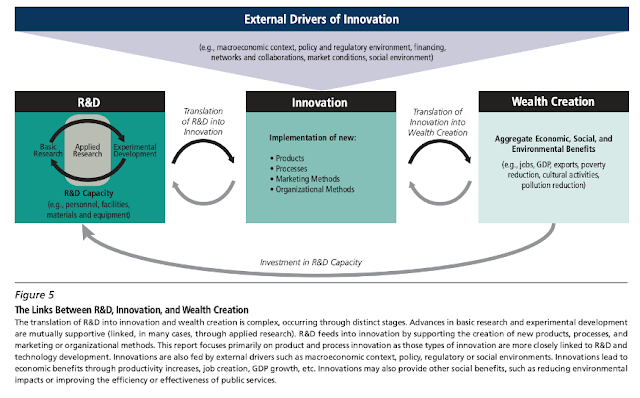
Post-Script: The Continuum of Research

I’ve written many times about this and why it matters. Developing the capacity and contribution for the span of R&D – from basic to applied research through to experimental development – is key to enacting intentional innovation. 


An excellent graphic from the CCA Report Competing in a Global Innovation Economy that describes the links between R&D, Innovation and Wealth Creation. 


Thursday, October 15, 2020

The Future is Micro: Learning that is developmental, iterative, and experiential

Micro-credentials are having their moment. For those of us who have been working with them for some time it seems like this has been a moment a long time coming. 

I’ve been giving micro-credentials a lot of thought lately as we here at eCampusOntario start to ramp up our work in the space. Our micro-credentials Framework offers a highly useful guide to implementing these, and has been used by the 36 pilots we have funded across a range of industries. And the eCampusOntario fourth annual micro-credential forum will take place in February 2021: have a look at the 2020 Forum re-cap page to learn more. 

Micro-credentials offer iterative and agile ways for learners to mark milestones in their learning journey. In an ideal world these will always ladder into successive credentials that enable learners to build on their knowledge and skills throughout their lifetime. We already have models of practice for this in the ways that we can transfer from diplomas to degrees.

If I think about the credentials I have earned that have formal recognition these are broken into two types: those that have been part of a laddered series of credentials (BA, MA, PhD) that form the basis for my formal education, and those that I have earned through professional development that I have earned throughout my career. These credentials have been developmental, and iterative

Formal credentials earned by (bottom left to right) UNBC, Queen's University, University of Toronto; (top left to right) MIT, University of Windsor, Kellogg School of Management
The path from formal credentials to professional development

But learning is much more than formal programming, as important as this is. Informal learning has played (and continues to play) a significant role in my developmental journey. In this sense my formal credentials are complemented by the experiential aspects of service to my community and my participation in communities of practice. This experiential learning is significant as it represents the wider constellation of experiences I have had that have all contributed in meaningful ways to my overall professional development, and my development as a human being. 

Image showing the logos from the universities where I have earned formal credentials surrounded by logos of institutions for whom I have done service, and so have learned from
The constellation of credentials and experiential learning

I had the occasion yesterday to catch up with a colleague with whom I worked many years ago. We were discussing micro-credentials and reminiscing about when we first connected on these back in 2012. And last week I was interviewed by my friend and colleague Laurie Harrison as part of our upcoming TESS conference (next week! Register here). We chatted about the work we used to do together (I worked for Laurie at the Adaptive Technology Resource Centre back in the early 2000s). This included creating short, online courses for teachers working to integrate people with special needs in the classroom as part of the Special Needs Opportunity Windows (SNOW). We didn’t call these micro-credentials at the time, but that’s what they were. 

The difference now is that we are working as a system (or set of systems) to more rigorously stand up micro-credentials as viable pathways to learning, be this for formal or informal learning, as well as for reskilling and retraining. This latter point is very key to helping our society in the pandemic rebuild and recovery. There have been many people laid off, furloughed or otherwise under- or unemployed, including due to changes being wrought because of automation. Micro-credentials offer a viable and valid model for ensuring that learners can access vital learning to support career progression and transition. Scaffolding learning in this way helps us ensure our recovery and rebuild is as inclusive as can be.

There is much work to be done on micro-credentials, and eCampusOntario is here to help. I am confident that we can work together to ensure access to education as part of our role in supporting the postsecondary system. As our SXD Lab puts it: our goal is to promote and enable purposeful learning for a meaningful life through the ongoing development of prepared citizens to participate meaningfully in the economy. 


Friday, April 24, 2020

Research, Remote or Otherwise (plus 3 geese)

Some really good announcements on the research front this week from the federal government, including ample new support for COVID-19 medical research and vaccine development in addition to Support for students and new grads affected by COVID-19 and support from the granting councils for research assistants to extend research scholarships, grants and fellowships via various programs for several months.

There is also an additional $250M in funding for firms to access via the Industrial Research Assistance Program (IRAP). The Logic's overview (paywall alert) also details changes to the SR&ED (mainly halting audits) that Minister Bains has outlined in the COIVD response package to supporting firms in Canada. One thing that should be done is to get the SR&ED program in line with its original terms and conditions and support more experimental development activities - the ED part of the SR&ED that has historically been ignored by those administering the program. This singular failure of the way in which SR&ED is administered needs an urgent fix now as we look to support firms to pivot and reframe their businesses in a COVID context. 

This new funding will go a long way to ensuring that we can continue supporting research as much as is practicable while some facilities are closed, and to pivoting into remote research where this is feasible. There are also new avenues of research opening up, for example in looking at ways in which we are collectively navigating the changes and challenges before us, from remote learning to remote systems and service delivery, through to how culture and cultural production is being adapted to mental health and well being. 

The opportunity afforded here is to enable Canadian researchers to help not only lead the world in navigating the immediate public health crisis, but also in adaptation of the economy. And speaking of local adaptation, below is a particularly Canadian adaptation to the 2 meter physical distancing rule - stay three geese apart!

COVID-19 sign from Toronto's Beaches that says Do Your Part. Stay Apart. The length of 3 geese.


Saturday, April 11, 2020

Instructional Design for Extensible Online Learning

"In those tumultuous and kinetic times, the time of actualised desire, I myself had only one desire. And that was, for everything to stop.”

Angela Carter’s The Infernal Desire Machines of Doctor Hoffman


Angela Carter’s fin de siècle science fiction novel presages an approximation of where we now find ourselves. The COVID-19 crisis has led to physical distancing and isolation from social context, with a concomitant social media “exercise in status display” taking hold in some quarters.

For postsecondary education we are told that “Universities, colleges face potential budget crunch as they assess impact of COVID-19 on international student enrolment.” This is an important reminder to the fragility of the economic basis in which we operate, namely the reliance on international student recruitment to fund the enterprise.

There is some hope: “time spent in an online course would count toward the time in Canada required to earn a work permit.” This is an important development that will aid our modelling of how we emerge from the current constraints, and into the mesocosm--an experimental enclosure--that will mediate and mitigate physical distancing in the time it takes to create a COVID-19 vaccine.

Scenario modelling could use a 50% probability basis for unpacking how we will return to in situ work. That is: we have a 50% chance of returning to face-to-face learning in September. And within this, that we will have to accommodate 50% less students on campus. This latter could be because of declining enrolments or physical distancing rules.

Basically this means we don’t know, but this should not stop us from modelling out the differing types of scenarios. We should do this while standing up the learning supports to enact a more flexible, distributed learning. Because either way, more remote learning is in our collective future.

Government and health leaders are advising that the current physical distancing practices will last months. This uncertainty, coupled with the COVID-19 experience of other jurisdictions, suggests that universities and colleges need to prepare not just for the long-term impact of the current physical distancing practices, but also for shorter-term approaches to address the continued need for physical distancing and isolation. Responsible, responsive curricula development necessitates significant changes to and adaptations of curriculum delivery, such as this is feasible within our programs, and which ensures that we collectively continue to provide positive teaching and learning experiences. This can be done while supporting and protecting faculty autonomy and prioritizing effective pedagogy.

Flexible learning is an approach that blends online (synchronous; asynchronous) teaching and learning with face to face (F2F) or in situ learning. While F2F learning will not be feasible in the short to medium term, we can start to anticipate a gradual return to this as it is imperative to reifying skill and competency development.

Alex Usher offers a good take on a post-pandemic collective effort in which the sector has an opportunity to collaborate on wider online learning development. This is smart--and optimistic--thinking. More and effective cooperation will help us build a system in Canada that can ensure students are provided with the appropriate scaffolding for learning now coupled with the ongoing iteration and development of a more robust realm of learning across sectors and levels. (As an aside, the National Research Council once had a whole research unit dedicated to e-learning, including the development of technologies, metadata standards; it was disbanded in 2006 or so).

Think of this as a way to offer a seamless student experience and a single point of entry into learning capable of bridging initial engagement to learning to employment to community building through alumni. Effective online learning as a core component of the larger pedagogical support structure will help us teach the skills and competencies that our learners will put into practice. This is the essence of “extensible online learning, where the goals of skills transference are made explicit in relation to online learning, and these skills are in fact transferred into practice” (Luke et al 2009).

There are various components to consider in the migration or transition into flexible learning:

1. Determining courses and course components that can be accommodated online
This will highlight curricula strengths, and it provides an opportunity to disaggregate programs and courses into microcredentials that can be stacked in potentially creative ways to achieve learning outcomes. This disaggregation will be important for our 50-50 scenario modelling.

2. Sequencing / Flexibility to continue delivering small–group f2f learning 
A modular, flexible learning approach will not only support new modes of teaching and learning but also allow us to continue to deliver core curricula. Online components of courses can be staged or sequenced to work in conjunction with in situ learning. This extensible online learning will help us achieve learning outcomes in a staged way, and also help us stage in situ learning with less people in one place at one time as need be.

3. Matching just-in-time remedial detours to support in situ learning
Having online content readily available and accessible and shareable via a robust learning object repository will enable learners to access content when and as needed to support in situ learning.

4. Exploring integration with other curricular models and systems provincially, nationally and even internationally 
By supporting an expanded set of learning approaches and curricular options for students, there is significant opportunity to explore integration of other systems, learning objects, courses, media etc, as per Usher’s point about collaborating to compete togethereCampus Ontario's Extend is one good example of this.

5. Ensuring iterative, agile development and evaluation
Develop and deploy evaluation instruments within courses that conduct formative and summative assessment on learning outcomes, in addition to faculty and student satisfaction, for continuous quality improvement. Online learning has been around for three decades at least. This is an unprecedented opportunity to not only leverage the research and insights gained through this time, but also to conduct ongoing research and evaluation of how best to stand up flexible learning.

Doug Saunders, writing in the Globe and Mail, reminds us of another science fiction writer, William Gibson, and the premise of “The Jackpot” that underwrites Gibson’s stories: “It’s not a big bang, but rather a lethal spiral of preventable disasters abetted by incompetent leadership and economic contraction.” “But there is hope” Saunders reminds us, in that “During this crisis, and in its long recovery, it would be a terrible waste if we did not spend in ways that also make the world a cleaner and more resilient place. If we have these higher goals in mind, though, we can turn a fatal spiral into a hopeful one.”


Friday, March 27, 2020

From anytime, anywhere, to all the time, everywhere

Many years ago (2001 in fact) I read a very insightful piece by Phil Agre: Welcome to the Always-On World. This piece has been on my mind of late as the world transitions into remote work. I am reminded of something a student once said - or rather posted in an online course I was teaching back in 2003 or so (in which I was referencing the above article). We were discussing the pros and cons about online learning, and talking about the phrase being bandied about then of the Internet enabling learning anytime, anywhere. This student said online learning is more like all the time, everywhere. 

While we all realize that working from home brings its own challenges - not to mention that it has amplified issues of accessibility, access and broader digital literacy - we are all realizing that it is important to have some boundaries, mostly time-based, but habitual as well. And in many respects learning all the time everywhere is what we do anyway. It is an apt representation of what we now call experiential learning. What the Internet adds is the connection to wider communities - communities of learning, communities of interest, and communities of practice. We are all engaging in some form of "legitimate peripheral participation" in which learning happens with our peers.

For those of us in post-secondary education making a wholesale transition into more online learning, as much to enable students to salvage current semesters as to scaffold the current reality into the new normal. In making this transition we have to recognize that not everything can be taught online, but we can - and we should - leverage the wider capabilities that online learning affords in order to support skills development and digital literacy more broadly.

This means we need to engage the cognitive, affective and psychomotor learning modalities, to help learners move from head, to heart to hand - to link thinking, with doing, and to do so with care.

I've been working on updating a model of flexible learning developed via research on this topic over the past couple of decades.


Diagram showing a circular model of flexible learning, connecting the conspicuous contribution of the academic enterprise with community learning and in situ making.


Monday, March 23, 2020

The skills that are in high demand are those most difficult to teach online

Global pandemic planning has led to emphasis on online learning to ensure that students can continue to learn and finish the current term. But maker skills, which are now more than ever in demand, are the most difficult to teach online. This conundrum underlies the transition to a new, social-distancing normal.

The current crisis has amplified a downside of globalization: the interconnectivity of market production has for the past several decades led to the hollowing out of manufacturing capability. Since the early years of the last decade there have been calls for and moves toward a reshoring of manufacturing--largely a result of a lack of jobs and the social risks of insufficient employment for large swathes of the population. This in turn has led to a commensurate focus on the skills and competencies associated with being able to build and make things. And herein lies the main irony of where we are in education: the skills that are in high demand are those most difficult to teach online.

As the global community starts to grasp the magnitude of the challenges we are collectively facing those of us in universities and colleges are starting to plan for unknown event horizons, including when to restart in-person instruction. While it is not feasible to think that whole societies can remain in socially distant quasi-isolation indefinitely, we are witnessing a wholesale move towards more online, distributed, or flexible teaching and learning. This means thinking through how we can translate educational outcomes adapted for distributed teaching and learning. It also means figuring how we might prioritize programming to account for and accommodate those whose programs have been disrupted. We'll need to work out the best means to stage online back into in-person engagements, and to adapt in situ learning to the inevitable new guidelines or rules around social distancing.

Throughout this it occurs to me that those same goals of globalization--of distributing the means of production to lower cost regions--has led to precisely some of the problems we face in online education. Everything from engineering to design to health care will have to adapt in the short term, which may lead to positive changes over the long term. Now is the time to focus on how effective pedagogy can drive the use of any technology, and to heed the decades of research into teaching and learning, particularly as mediated through technologies like the Internet.