Showing posts with label intermediaries. Show all posts

Tuesday, January 25, 2022

Some missing links in the discussion on innovation

Much digital ink has been spilt over the nascent Canadian version of the storied DARPA, including a good overview by Alex Usher today. Usher rightfully points out some dissonance in the focus on disruptive versus incremental innovation; this incidentally confuses the difference between invention (new to the world) and innovation (new to a market). He also questions the focus on product innovation over process innovation, but misses marketing and organizational innovation. But his point is sound: “simply adopting big-country solutions is unlikely to help us overcome them.” 

In thinking this through there are two key points that are missed here and elsewhere (see for example this piece in the Logic). The first is the importance of private+public partnerships for R&D, and the second is a focus on demand-driven innovation. I would add a third here, which is the turn (finally) in Canada to a focus on the entire spectrum of R&D, and here I mean TRLs 1-9. More on this below.

Private+public partnerships for R&D (what I’ve elsewhere called P3RD) are essential for ensuring intellectual property (IP) generated in our world leading public research universities gets to markets. These partnerships are also essential for helping businesses to perform R&D and to innovate more broadly. Not only do research partnerships with higher education institutions helps companies to conduct R&D they might not otherwise do, they also give students valuable work integrated learning opportunities. This results in innovation literacy: “the ability to think creatively, evaluate, and apply problem-solving skills to diverse and intangible issues within industrial problems and multidisciplinary contexts.

Demand-driven innovation is the opposite of what Canada has focused on in terms of Science and Technology policy. That is, we invest more per capita than most every other OECD country in publicly funded research, but we lag on business investment in research and commercialization. Read the CCA Report on Science and Technology – it is a comprehensive overview of the particular values, strengths and weaknesses of the Canadian research to innovation ecosystem. 

According to the Horizontal Review on business innovation and clean technology (2018) – which while 4 years old is still a good barometer of S&T policy – most business facing R&D support is for early stage effort (what the OECD Frascati Manual calls Basic Research). The Horizontal Review further outlines the following:

  • Only 78% of support is focused on traditional product and process innovation and formal R&D
  • Less than half of funding is directed to firms that are in a growth stage, and
  • Only 8% support goes towards productivity enhancing technology adoption.

A focus on technology only (product innovation) disadvantages inclusive innovation, especially in the world of intangibles, a point made very clear by Ontario’s Expert Panel on Intellectual Property

As Alex Usher points out, according to Mazzucato the private sector does not generally invest in early stage research. And the public sector is not historically motivated to carry forward commercialization, preferring to publish results rather than commercializing them (though this is changing).

Most academic research is basic research – very little is applied research and hardly any is experimental development. This continuum matters. A lot:

The continuum from basic and applied research through to experimental development constitutes the types of activities that make up the innovation carrying capacity of national economies: the ability to proactively create value from public investments in basic research by fostering private sector receptivity and engagement to the public S&T systems.

Only 20,000 – 2% - of Canadian companies file SR&ED claims, the most reliable indicator we have for firms that conduct R&D activities, which are essential for innovating products and services for global markets. This is down from 25,000 a half decade ago. This may be only .5% of companies overall, but it represents a 20% drop in SR&ED filers. SR&ED is also down from 4 billion to 3 billion annually. This is not a good indicator for Canadian innovation. We can take from this the stark reality that not enough companies do R&D, and those who may be unsure if they want to conduct R&D have little or no incentive to start.

And this gets me back to the point missed by Usher and others. The discussion around a Canadian DARPA is worthwhile as it gets us into the mindset of developing challenge-based research capabilities. It socializes the idea that private+public partnerships for R&D is a good thing (this is the key DARPA model, along with limited time and funding). It puts us into the mindset that demand-driven research and innovation challenges are the right thing to do – to orient the best and brightest capabilities we have in our higher education institutions to address key challenges, be these health, environmental, social, or economic. 

The good news is that there are many working in this space. Check out OCI and Mitacs, who fund excellent programs that engage colleges and universities in all forms of research. Check out the good work happening at Communitech and their focus on “True North - solving Canadian problems with Canadian Innovation.” And check out how eCampusOntario is helping our 50 member institutions create research partnerships through a unique demand-driven innovation platform piloted with the City of Toronto

Working together we can mobilize the latent R&D capacity in our higher education institutions to increase the numbers of firms doing R&D with explicit reach out to those firms currently not innovating. Together we can aid the economic recovery and growth with Ontario-made innovation. Research partnerships have broad application and net benefits to our social and economic prosperity, supporting:

  • Commercial Innovation via industry-sponsored R&D and commercialization of University research 
  • Career opportunities for post-secondary graduates by providing relevant work experience and building their professional networks
  • IP and Innovation Literacy by integrating student experiential learning and issuing micro-credentials for project work with partners 
  • Employment and economic development by enhancing overall effectiveness of adjacent R&D for programs by providing a common entry point for Ontario businesses.

CARPA or no, the discussion around demand-driven innovation and research partnerships is right-headed. Not only that, but these are essential for competing in the global innovation economy. 


Post-Script: The Continuum of Research

I’ve written many times about this and why it matters. Developing the capacity and contribution for the span of R&D – from basic to applied research through to experimental development – is key to enacting intentional innovation. 
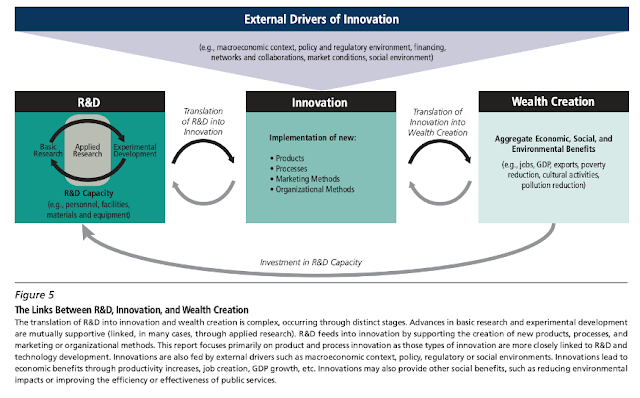

An excellent graphic from the CCA Report Competing in a Global Innovation Economy that describes the links between R&D, Innovation and Wealth Creation. 


Friday, April 24, 2020

Research, Remote or Otherwise (plus 3 geese)

Some really good announcements on the research front this week from the federal government, including ample new support for COVID-19 medical research and vaccine development in addition to Support for students and new grads affected by COVID-19 and support from the granting councils for research assistants to extend research scholarships, grants and fellowships via various programs for several months.

There is also an additional $250M in funding for firms to access via the Industrial Research Assistance Program (IRAP). The Logic's overview (paywall alert) also details changes to the SR&ED (mainly halting audits) that Minister Bains has outlined in the COIVD response package to supporting firms in Canada. One thing that should be done is to get the SR&ED program in line with its original terms and conditions and support more experimental development activities - the ED part of the SR&ED that has historically been ignored by those administering the program. This singular failure of the way in which SR&ED is administered needs an urgent fix now as we look to support firms to pivot and reframe their businesses in a COVID context. 

This new funding will go a long way to ensuring that we can continue supporting research as much as is practicable while some facilities are closed, and to pivoting into remote research where this is feasible. There are also new avenues of research opening up, for example in looking at ways in which we are collectively navigating the changes and challenges before us, from remote learning to remote systems and service delivery, through to how culture and cultural production is being adapted to mental health and well being. 

The opportunity afforded here is to enable Canadian researchers to help not only lead the world in navigating the immediate public health crisis, but also in adaptation of the economy. And speaking of local adaptation, below is a particularly Canadian adaptation to the 2 meter physical distancing rule - stay three geese apart!

COVID-19 sign from Toronto's Beaches that says Do Your Part. Stay Apart. The length of 3 geese.


Tuesday, September 17, 2019

Research and the Transit of IP

The Ontario Expert Panel on Intellectual Property has recently convened discussion sessions intended to unpack and answer the questions of their mandate. 

Ontario, like many other jurisdictions around the world, is wanting to achieve more outcomes from the investments made in basic research. This is reasonable. Research and innovation policy discussions over the past couple of decades (at least) are concerned with how best to leverage the country’s research capacity into positive social, economic and cultural outcomes.

There are of course several issues with any model that seeks to enable more direct return on investment in basic research, chief among these is that there is seldom a straight and single path to commercialize an invention. And, the aims of science (and here I mean the entire research enterprise across all disciplines) is to create knowledge and freely share this. This is at odds with creating value in the economy.

Still, Canada – and Ontario – would do well to leverage the platform we have: world leading basic science facilities, excellent applied research and experimental development capacity, particularly in the Technology Access Centres, various innovation intermediaries and economic development agencies, and a multicultural population which is suitable for launching products and services into any country.

Key here is ensuring we can create a structured receptor capacity to support the transit of IP from idea to invoice. The logic model for Capacity and Contribution among research performers, which I have previously discussed, is one way to look at how we can better knit together the various system actors and enable them to play to their strengths.

I look forward to seeing what the IP Expert Panel puts together in December.

Research-Innovation Capacity and Contribution Logic Model


Thursday, April 12, 2018

Council of Canadian Academies launches latest expert panel report: Competing in a Global Innovation Economy: The Current State of R&D in Canada.

This week saw the launch of the Council of Canadian Academies’ latest expert panel report, Competing in a Global Innovation Economy: The Current State of R&D in Canada. This report offers the most comprehensive view of the Canadian science and technology ecosystem, and its strengths in both capacity and contribution. Here is what the CCA summary says about the report:
Competing in a Global Innovation Economy: The Current State of R&D in Canada is the fourth report from the Council of Canadian Academies (CCA) in a series documenting Canada’s S&T and R&D strengths and weaknesses. It assesses the latest evidence on Canada’s R&D and innovation performance, combining up-to-date data with expert insights and analyses, and benchmarking against the performance of other countries. www.scienceadvice.ca
The expert panel had a wide remit, charged with considering the areas of excellence in basic research, applied research and experimental development, in both public and private sectors. Further we were asked to discuss how these inputs relate to our collective capacity or wealth creation – social, cultural and economic.

The data show that Canada has clear research strengths in several areas in terms of magnitude, impact, and growth: Clinical Medicine, Public Health and Health Services, Psychology and Cognitive Sciences, Philosophy and Theology, and Visual and Performing Arts. However, Canada now stands well behind the OECD average and is ranked 33rd out of 40 countries on an index of business R&D investment, intensity, and growth.

This is a worrying trend. More worrying is the fact that “Canada is now a net exporter of patents, and the outflow of patents is accelerating. In 2003, approximately 96% of the patents invented in Canada were owned in Canada. By 2014, that figure had dropped to 74%.”

Notwithstanding a lack of business investment in R&D, Canadian businesses do excel at fields, based on a composite indicator of magnitude, intensity, and growth, that includes:
  • Scientific research and development services
  • Computer systems design
  • Communications equipment manufacturing
  • Aerospace products and parts manufacturing
Overall, on the connections between R&D, Innovation & Wealth Creation the panel has this to say:
While Canada is a highly innovative country, with a robust research base and thriving communities of technology start-ups, significant barriers — such as a lack of managerial skills, the experience needed to scale-up companies, and a high rate of foreign acquisition of high-tech firms — often prevent the translation of innovation into wealth creation.
Dr Max Blouw, President and Vice-Chancellor Emeritus of Laurier University and Chair of the Expert Panel, and I were interviewed for Research Money article (paywall alert). When asked about the report and what was most significant to me, here is what I said:
“For the first time, there’s a strong linkage between the production of knowledge … and what the private sector does,” says Dr Robert Luke, VP Research and Innovation at OCAD Univ and member of the CCA expert panel. “It’s the most interesting aspect (of the report) – the connective tissue and propensity to leverage excellent knowledge in Canada.”
The idea of connective tissue is important, as we found there are strong and growing links between academic researchers and the private sector. While there are disparities in cultures (to be expected) that are exacerbated by different motivations (academics by tenure and promotion; read: publications; the private sector by sales), these are not insurmountable, and there are positive signals to build on with respect to enhancing the retention of IP in Canada and standing and scaling up global businesses here.

Fundamentally this is about ensuring the we can successfully de-risk long bets in research and capitalize on these downstream. Certainly not all paths from idea to invoice are linear nor simple, nor is every discovery immediately applicable into useful and usable contexts. But the report data show that we should all be asking what we get out of our investments in public science. Being excellent in research that fuels other countries’ economies is suboptimally oriented toward Canada increasing – let alone maintaining – our productivity.

The report is strong evidence for the efficacy of public+private R&D partnerships and the need to encourage these. Doing so across the entire spectrum of public and private sector actors will increase our collective capacity to make positive contributions to social, economic and cultural productivity.

Download the report here, and check out the CCA’s microsite that provides an excellent overview of the data.

The Council of Canadian Academies’ latest expert panel report:
Competing in a Global Innovation Economy: The Current State of R&D in Canada
As a member of this expert panel I can attest to the extremely high level of rigour that went into assembling it and performing the review and analysis of data. It was truly an honour and a privilege to be able to work not only with my colleagues on the expert panel, but also with the CCA staff, who brought to the task a dedication to excellence and exacting standards.

Tuesday, February 27, 2018

Budget 2018 delivers smart science policy

The federal government's Budget 2018 is an advance for the science, research and innovation communities. The overall approach to gender equity, diversity and decolonization is important and timely.

The government has clearly heard the call from the Fundamental Science Review to increase our investment in research. There is a strong focus on supporting interdisciplinary and international collaborative research, which is essential for not only uncovering new areas of knowledge, but for realizing the value of ideas as they are translated into application, products, services and other innovation. This underscores the importance of design disciplines as crucial to Canada's innovation carrying capacity.

And here's the big news: "Budget 2018 proposes an investment of nearly $4 billion in Canada’s research system to support the work of researchers and to provide them access to the state-of-the-art tools and facilities they need" (p 82).

This is smart policy. Linking investments in science and technology ($3.2B investment in "research" writ large) to national priorities and, importantly, diversity and decolonization, is imperative for inclusive innovation. It is also in line with other leading OECD countries that set national priorities and focus on the spectrum of research - from idea to invoice - in order to realize the benefits of public investment in the production of public knowledge.

The most important aspect of this budget for innovation policy is the section on Leveraging the Full Potential of Business-Academia Collaboration. Changes and investment here to NSERC and CIHR promise to make public+private partnerships for R&D (P3RD), and additional funding for colleges continues the growth of capacity in the college sector to perform an important innovation intermediary function that links skills development to product and service development. The special focus on the Technology Access Centres is important as these are exemplary organizations adept at enabling private sector innovation.

The focus on the spectrum of research - from Basic Research, Applied Research to Experimental Development - is picked up in the re-imagining of the National Research Council (NRC). New investments in the NRC are absolutely necessary and essential to enable the NRC to start to really expand a focus on translating the world leading ideas uncovered in Basic Research into real innovation in the world. Among the $1.1Bn in funding that provides important inputs to capacity, the NRC gets a DARPA-like entity "to fund its scientists to work with innovators from post-secondary institutions and businesses on multi-party research and development programs." This is long overdue.

But things get really interesting in the Innovation Canada – Accelerated Growth Service section and "the creation of four flagship platforms" to deliver business innovation programs. I have elsewhere outlined the importance of focusing on the full spectrum of research activities and the lack of investment in Experimental Development (see my Capacity and Contribution Logic Model). This is a significant development that promises to help get more ideas turned into invoices by helping manage the process of research through to experimental development through a simplification of business innovation programs (a result of the Horizontal Review that Budget 2017 called for).

The Women Entrepreneurship Strategy is welcome news. This will help us focus on those outputs of innovation that are not typically valued, as outlined in this excellent article  from last week. This adds to "the Government’s coming reform to federal innovation programs [that] will include a universal goal to improve the participation of underrepresented groups, including women entrepreneurs, in the innovation economy." I also read with note the Intellectual Property Strategy. The launch of a Patent Collective is long overdue - all publicly-funded R&D performers should enter such a patent pool to mobilize stranded IP.

This is good science and innovation policy that provides new funding support for Basic Research, and support and services for Applied Research and Experimental Development, notably within the purview of public+private partnerships for R&D (P3RD). The diversity lens is essential and will result in a more inclusive Canada.

This is #smartsciencepolicy.

A Capacity and Contribution Logic Model incorporating TRLs and Frascati research definitions

Monday, November 7, 2016

Partnerships and resilient regional economies

For some time I've maintained that partnerships are a key unit of analysis for the development of a robust innovation economy. More to the point, we need to foster and encourage public+private partnerships for research and development - or P3RD. The P3RD Participatory Innovation model provides a mechanism to understand and support the innovation carrying capacity of national economies: the ability to proactively create value from public investments in basic research by fostering private sector receptivity and engagement to the public science and technology (S&T) and private research and development (R&D) systems.

The function of innovation intermediaries are core to Public+Private Partnerships for Research and Development (P3RD). We can best understand this function by looking at how national governments measure R&D and innovation activities. For this we can turn to the OECD Frascati Manual, which outlines Basic research, Applied research, and Experimental development as the continuum of R&D – from idea to invoice.
Basic research
“…is experimental or theoretical work undertaken primarily to acquire new knowledge of the underlying foundation of phenomena and observable facts, without any particular application or use in view.”
Applied research
“…is original investigation undertaken in order to acquire new knowledge . . . directed primarily towards a specific practical aim or objective.”
Experimental development
“… is systematic work, drawing on existing knowledge gained from research and/or practical experience, which is directed to producing new materials, products or devices, to installing new processes, systems and services, or to improving substantially those already produced or installed.”
(OECD Frascati Manual 2.1.64)
This continuum matters, and the goal in standing up P3RD is to locate the activities undertaken within this context. The continuum from basic and applied research through to experimental development constitutes the types of activities that make up the innovation carrying capacity of national economies: the ability to proactively create value from public investments in basic research by fostering private sector receptivity and engagement to the public S&T systems. 

Here is a useful article on the value of partnerships, and the author's perspective on this uniquely Canadian approach. I've called this barn raising the innovation economy. P3RD enacts a participatory innovation and creates resilient regional economies and clusters. More on this in the months to come.